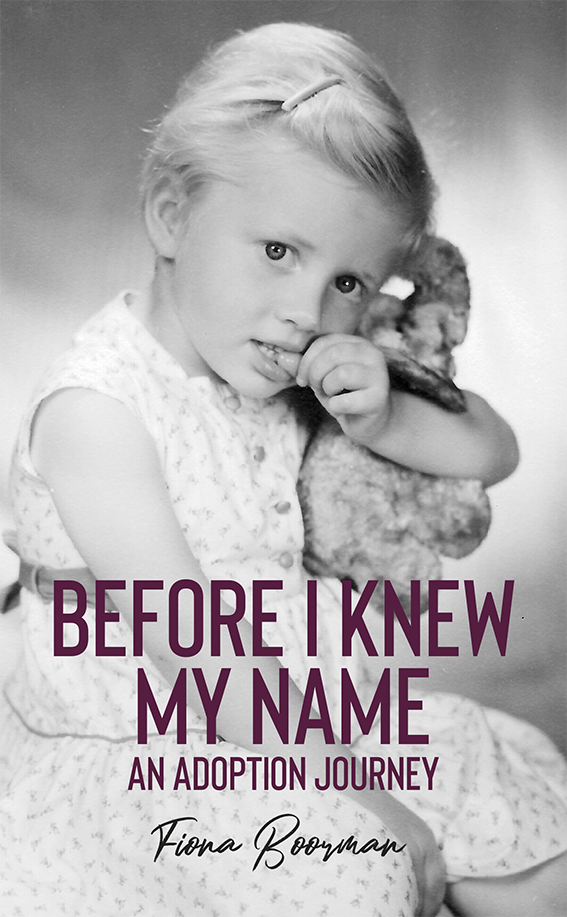
Before I Knew My Name
Silver Biography, 2023
When Fiona Boorman learned she was adopted, as a young girl, the news barely registered. But when Fiona became a mother herself, unanswered questions became impossible to ignore. Her search eventually led to the woman, Marjorie, who had given birth to her and an unexpected discovery. Fiona wanted to write about the story of finding Marjorie, and all that followed, preserving it for her children, grandchildren and generations to come.
‘I couldn’t be more pleased with the outcome. The whole process was beautifully organised and was also cathartic for me’
– Fiona Boorman
A sample chapter: ‘Who Am I?’
I was 11 when I learned that I was adopted, or, as my mum and dad put it, that they had ‘chosen’ me. I assume they had been advised that the stage just before a child starts secondary school was the right time to do it. It would have been awful to find out from a classmate, after all.
If they expected me to be shocked or upset, I wasn’t. I simply accepted it. At that point it didn’t seem important that I had been born to someone else. They were my mum and dad, I was their daughter and I loved them.
As I hit my teenage years, however, my attitude started to change. My adoption became a useful weapon in rows with my parents. I remember, shamefully, telling Mum that I didn’t need to take any notice of what she said because she wasn’t my real mother. Ouch! But I didn’t give any real thought to it beyond that. I didn’t stop to wonder who my birth parents were or why they had given me up. I certainly didn’t feel any desire to find them. I was too busy getting on with my life.
Then, aged 33, everything changed. Pregnant with my first child, I was asked if I knew of any hereditary diseases in the family. Of course, I couldn’t answer. It was then that it struck me, for the first time really, that being adopted was a big deal. When Katie was born, in November 1990, I found myself gazing at her and wondering whose characteristics she had inherited. I could see elements of her dad, Steve, and of me, of course. But what if she had traits that came from my birth mother? How would I know?
Suddenly, the curiosity I had experienced when I was pregnant became a burning desire I could no longer ignore. I had to know where I had come from. I had just become a mother, and it felt natural that I should try to find the woman who gave birth to me.
By coincidence there was a programme on the BBC in 1991 all about adoption. I watched avidly as the participants went through the process of tracing their birth parents, and I wondered what it would be like to find my own. As Steve and I got to grips with looking after our new baby, I decided I couldn’t wait any longer. I wrote to the producers of the BBC programme explaining that I wanted to trace my birth mother but didn’t know how to begin. A few weeks later I received a letter from the Post-Adoption Centre—an organisation that offers advice and support on adoption—who told me my enquiry had been passed on to them. They enclosed information on how to begin searching for a birth parent. As I read through the leaflets it became apparent that it was likely to be a long and laborious process that would bring up a lot of strong emotions. It was possible, they warned, that I may not be able to trace my birth mother. Even if I did manage to find her, I understood that she might not wish to meet me.
While it was a daunting prospect, I wasn’t as worried about any of those possibilities as I was about telling my mum and dad what I was doing. Although we had never discussed the idea of me looking for my birth mother, somehow I knew they would be desperately hurt. After they told me I was adopted all those years previously, we had never spoken about it again. Perhaps they hoped by not mentioning it I would forget about it. It was true that I hadn’t given it a lot of thought up until then. They may have thought I wasn’t aware I had the right to trace my birth parents; when they adopted me it was almost impossible for adopted children to find their biological mother and father. In any case, I decided I wouldn’t tell them I was searching until I had some sort of resolution. There was no need to upset them unnecessarily.
The first step, I had learned, was to apply for my full birth certificate from the Registrar General.
It was possible my parents already had the document, but I didn’t want to ask them. All adoptive parents knew the details of a child’s birth—they had to submit a copy of the birth certificate to the court when applying for an adoption order. But it was up to them whether they decided to make copies and, later, whether they chose to share that information with the child. My parents had only ever given me a shortened version of mine.
By then I knew that under the 1975 Children Act I had the right to request access to my birth certificate, as well as details of which court or agency had handled the adoption. That’s if the adoption had gone through a formal process, of course. It seems incredible now, but right up until 1984, when adoption agency regulations were brought in, anyone was able to arrange a private adoption. It didn’t have to be conducted through the local authority or via an agency. The local council had to be notified by the prospective adopters and to conduct a welfare assessment at their home, but this was only after the placement had been made.
Before I could see my birth certificate, I had to agree to be assigned an intermediary via the local council. The intermediary would help me to trace my birth parents and also act as a go-between in any contact. At this stage I didn’t know if my birth mother was even alive, or if she was whether she would be happy to be found. My mediator, a woman called Tess Mundy, was there to help me navigate the process. But, she cautioned, there was only so much she could do if my birth mother did not want to be in touch with me. I could only contact her if she agreed to it.
Maybe I should have been intimidated by the process I faced. But I had become so certain that I had to try to find my birth mother that I didn’t stop to consider what lay ahead. I just wanted to get started.
To my surprise, the first birth certificate Tess was able to track down was not my own but that of my birth mother. For the first time I knew her name: Marjorie Heppelthwaite, born October 8th, 1920 at 217, Gipsy Road, West Norwood. It was surreal to see this information for the first time, handwritten and official. My sense of who I was began to shift as I looked at the name of the woman who had carried me, given birth to me, yet was not my mum. But Marjorie Heppelthwaite was just a name on a piece of paper. It was disorienting to think that I had once belonged to this woman.
When I received my birth certificate a short while later more detail was filled in. Marjorie Phyllis Heppelthwaite was described as a single, 36-year-old telephonist whose address was given as Gipsy Road, West Norwood, in the London borough of Lambeth. I had been born at Dulwich Hospital before Marjorie took me to a mother-and-baby home.
I would later learn that unmarried mothers were often sent to homes like this. There was much shame then surrounding pregnancy outside of marriage. Women who found themselves in the same situation as my birth mother and were unable to support a child on their own only really had two choices: a dangerous, backstreet abortion (abortions being illegal up until 1967) or adoption. Many went into mother-and-baby homes to see out their pregnancies, and some would give birth there. Then, when the babies were around 20 weeks old, they would usually be adopted.
My birth certificate showed that Marjorie had named me Linda. Linda? I had of course only ever thought of myself as Fiona. The section about my father’s name and occupation had been left blank, but again this was not unusual in the circumstances. An unmarried woman could not name a man as the father of her child unless she had gained an affiliation order against him—meaning a court had agreed he was the father. Alternatively, the father could accompany the mother to register the birth, where they could both give their individual details. But this was challenging in the days when most women remained in hospital—or at the mother-and-baby home—for at least ten days after the birth, and the registrar would visit the maternity ward to register babies. Only husbands were permitted to visit the ward, so it was difficult for an unmarried father to be named on the birth certificate even if both parties wanted him to be. It’s unlikely those running mother-and-baby homes would have gone to any effort to assist either, since it would have meant extra work for them. If the father was named on the birth certificate, they would then need both the father and the mother’s consent to the adoption.
In any case, I was not especially bothered about my father. It was Marjorie I wanted to find.
With thanks to the Fiona for allowing us to share part of her story. All copyright remains with Fiona Boorman.
Preserve your memories in a carefully crafted book that your family will treasure forever
Find out more about our memoir writing services: